Sunday, October 6, 2013

Reading And Writing Violently


In an on-line group of genre fiction writers I'm affiliated with, there's a discussion going on about violence in writing. It's centered around this essay by Warren Ellis. While Ellis is widely experienced as a scriptwriter, essayist, and novelist, he's best known as a comic book writer. He's one of the best working in the mainstream these days, or at least he was a few years back when I was current with the industry. For the record? This post may seem as if I'm arguing with him. I'm not. I'm explaining myself to my friends.

I got called on losing my temper in the discussion, or at least showing signs of tension. I was a little irked by the essay. I thought it dismissed the actual failings of Ellis's work at its worst, and failed his work at its best. Which is a polite way of saying I thought it was a bunch of self-rationalizing horseshit. HIs position is that many people are confused by the presence of violence, and it's up to works like his to help them understand.

Given my own habit of writing on violence, this would seem to be the kind of statement I'd support. But I think this is a paper tiger. I do not think people who can't understand violence have a problem or represent a problem. And if they do, I don't think violent pop fiction will help them. I'm wrestling with the issues involved in violence in the media very intimately right now, and this statement from whose work I've enjoyed and in some cases admired bothered me.

For those who are not familiar with Ellis's work, as I said, he's one of the standout writers in comics these days. He has written works that he could point to in defense of his position, Fell coming to mind immediately. There hasn't been a better historical comic than Crécy, which is as violent as you could ask for.

But in the majority of his comics work, violence is used as it is most typically used in conventional adventure fiction. It is there to make the lead characters appealingly potent, to establish their value and authenticity. It is there to titillate the reader, and it is frequently executed by lightly- clad men and women intended to appeal to the shallow male gaze. Most troublesome to me, it is portrayed as a legitimate and functional first response to problematic situations, especially useful as a means of establishing and maintaining hierarchy.

I am not arguing that he needs to defend that work.  I have bought much of it, read much of it, and will pick it up and read it with pleasure again.

But it's frequently nasty entertainment. It's not wholesome. That's why I like it. There is a certain British culture of grinning, brutal violence that appeals to me, and Ellis is a fine practitioner of the tradition. But I don't always approve of the things I enjoy. And I won't argue that they have social virtue, because I don't believe it.

When I was in high school, I worked as a teacher's aide and janitor at a day care center. This was during the late seventies, early eighties, and there was a brief Marvel Comics trend as a result of the Hulk TV show. Fights were unusual at the day care center; the kids were upper-middle class, and didn't get hit much at home, so they had to come up with their own sources for the violent impulse. T-shirts were useful in this connection. If a kid wore a Spiderman shirt, they would probably get into a fight by the end of the day. If they wore a Hulk shirt? They would fight. Every time.

I could say that it was because the Hulk TV show taught kids that losing your temper and breaking things fixed problems, but that would be bullshit. It was the image of the strong, violent man that possessed them. If you watched them, you could see them puffing and flexing as the shirt convinced them that they were the Hulk.

The shirt work the kid, and the shirt started the fights. My feeling about violence and the media is that of the old boy who was asked if he believed in baptism. "Believe in it? Hell, I've seen it!"

During that same time, I played a lot of wargames and role-playing games. One of my friends was a former gang member. One night, he found out a friend of his had been stabbed in prison and was on the critical list. We spent that night playing the Melee programmed adventure Death Test. Melee was a game simulating hand-to-hand combat, and we spent the night engaged in slaughter, adding one wet red detail after another to dramatize the roll of the dice and the addition and subtraction of strength points.

My friend was able to sleep that night. I also believe there is such thing as catharsis, and it can serve a healthy function in entertainment.

I come from a history of violence. I relish much violent entertainment. In my own work, I struggle to reject using violence as a means of entertainment, and I do so with difficulty. For someone raised by the US media, violence is an element of entertainment the way hydrogen is an element of water. And that's one of the central problems.

It is impossible to show someone triumphing in an act of violence without making them attractive in that moment, and that will stir a longing for that sense of triumph in some percentage of the audience.

Can't be done. You can't show someone as powerful and decisive without having people fall in love with them on some level. It's one of the awful design flaws in human nature that have me wishing I belonged to a classier species. Effective people are attractive even if they are having terrible effects on the world around them. Gordon Gekko from the movie Wall Street was intended to be an absolute takedown of a particular type, and instead he became the role model for people in the finance industry.

Or to put it another way. In terms of actually affecting people's behavior, models always work and morals never do, and that is the moral of the story.

But to say that one should always show violence in a negative light, that it is necessary to show the violent person as something the audience should not want to be, is a little pat. And not necessarily the most ethical stance. Because people do face situations of violence in their lives, and fiction provides them with models for handling it. And people's lives can be powerfully affected by their choice of models.

When I first began writing seriously, I intended specifically to write action-horror novels. I was fixated on violent imagery, and I wrote with the intent of forcing the experience of violence on the reader, of making them live through real trauma. However, I found myself unable to sustain interest in violence in itself. And little of my work from that time reached completion. I had no clear idea of how to tell a story.

I devoured violent material. I read a lot of true crime, for instance. After a certain point, I realized that I was actually titillating my own blood lust, reading of loathsome acts and then explicitly imagining fitting retributions. I could feel it degrading my character, so I stopped.

But I still liked the stuff that could actually put scenes in my mind, generate a physical response, get my heart racing, make me break a sweat.

That's because I am addicted to stress reactions, and I can use media as a trigger for an endogenous drug experience. In my case, the pathology is visible, but this dynamic underlies many relationships with fiction. It's only pathology if it goes too far.

A few years back, I was hospitalized with a stress reaction and diagnosed with post-traumatic stress disorder. When I began to write and perform autobiography, I soon found myself confronting one of the classic symptoms of PTSD -- a disorganized personal story. I had to go back and look at my experiences and walk through them one step at a time, establishing the connections.

The act of writing and reading these works proved tremendously therapeutic. Not only was I confronting my social anxieties and fear of crowds, I was finding out what my story actually was. And once I knew my story?

I could stop worrying about it. And because of that, violence is no longer a subject of primal interest for me. I no longer wish to deal with it as a central issue in my work. If it comes up, it comes up, but I'm not going to go looking for it at this point. I still have a taste for the old vino, but I'm more likely to reject a vicarious violent experience than accept one. I've come to recognize that they're actually hard on me, that they promote ambient levels of stress, and now prefer fairly low-key entertainment for the most part.

The place of violence in my writing has changed. In my current novel, yes, there are two fight scenes, but in both instances the protagonist is a chicken, and no humans are harmed. The central plot rarely involves raised voices, let alone thrown pillows. Or punches. I'm more interested in portraying things being built than broken. I still have some adventure fiction in me, but the idea that adventure = violence is being subjected to stress tests.

What I'm suggesting here is that rather than being a form of revealed reality, most violence in popular culture is a response to trauma and unprocessed rage and fear, and the more extreme the portrayal of violence, the deeper the likely wounds in both creator and audience. I'm suggesting that most portrayals of violence in popular culture reinforce the existing mental and social patterns, drawing the same graffiti over and over again, and it is only through great and painful effort that we can hope to approach works that are actually transformative, or at least have the merit of truth.

Too many writers are either powered by a slowly fading inchoate adolescent rage, or engaging in vicarious fantasies of potency, and they don't usually give us useful stories. Fun stories, entertaining stories. But are they helpful? Really?

What I'm saying is that if you are actually opposed to violence, don't promote it. Don't make the violence thrill. Blood in your eye just blurs your vision.

Monday, September 30, 2013

Binary Clod

(Photo by Deborah Kuchar)

Confronting my social anxieties and sense of alienation has led me to have a much greater interest in people, and the more I find out about them, the more I understand just how weird I actually am.

On one hand, I am nearly fifty years old, in debt, and conventionally unemployable. On the other hand, I am an oddly accomplished and impressive individual. "I'm worried that you might be experiencing grandiosity, but it's hard to tell," my counselor told me at one particularly ebullient point, only to qualify that statement later in the session with, "No, you're definitely not grandiose, you actually are what you look like. But we might want to keep an eye on things."

I am dead broke. Have been for years. Despite this, between my hobbies and my friends, I live a middle-class teenage dream life in many ways. And I have to fight to appreciate my prosperity, while the poverty is slowly smothering me.

To tell a homeless man that I can't give him money feels terrible. To do it on the way to the store with exactly enough money for a pre-decided purchase makes me feel like a turd with a cherry on top. But this guy has told at least one woman my name, and now I have to say no to her as well. And he has medical coverage and I don't.

The trivialities of the pleasures which sustain us are impossible to rationalize when held against the cost to the world as a whole, and if I do not engage myself thoroughly and productively in the world of trivial pleasures, it causes hardship to those immediately around me.

Again, from counseling: "The thing is, all of these mental illnesses and symptoms are actually advantages under the right circumstances. When I'm really functioning, it's all useful." My counselor said, "That's not the way it usually works, but in your case it's true."

I have always regarded myself as a cipher, an invisible man, a social and sexual nonentity. Oh, brother, who was I trying to kid? The problem is that I am the exact opposite. I am a projector, I am one of the people who sets the tone of the room. The problem is that a lot of the time I am fucking miserable.

But when I'm not, holy shit. Nobody warned me about this. It turns out that thing I do with animals and kids works fine on adults, I just never thought to try it. Now I have to be fucking careful not to let it get out of control. People pushing me ahead in line, cashiers giving me discounts, people starting conversations with me and then asking me if I'm an artist or writer and then asking where they can find my work. I seem to look as if I'm a big deal of some kind.

It is like an on/off switch. Either I scowl at the ground, or I am socially engaged. I was never invisible. I was just refusing to respond to the people around me. Given my early years, of course I refused to respond to the people around me.

It was only on Friday that I finally understood the look. I frequently find people giving me a look that is all eyes and no mouth, a straight stare that always impressed me as hostile, always aroused a feeling of physical defensiveness. And a lot of the time, it comes from people I find attractive. This is one of the main reasons I've always assumed that women have a specific distaste for me. (Most of my closest friends have been women, and I usually wind up bitching to them about this, and yes. Yes, there is irony here.) You know what the look is? It's someone who's been caught staring, and who doesn't know how to respond, and can't quit.

A lot of what I've experienced as hostility in life makes more sense if I assume that I'm someone capable of arousing strong emotions in people, and sometimes those emotions cannot be fully controlled, and sometimes they don't feel good. I always knew this was true of everyone else, but now I know I'm in the game. And I'm not used to it. It's intimidating.

And it's playing out at home. My relationship with the missus is in some ways better than ever, but there's a roller-coaster aspect to things. We're both people who live in a permanent moment, and when I'm up, she's thrilled with me, and when I'm down, she's not. And I'm up and down. A lot. So one day I'm a hero and the next I'm a slug, and a spouse is supposed to dampen your mood swings, not accentuate them.

Under other circumstances, the downs would predominate. My current anhedonia and irritability would typically indicate a paralytic depression, but I've got a lot of work to do, and it's all going to particular people. I'm too connected to the world to go into a complete depression.

But I've had enough good experiences over the past few years to understand something of what it feels like to be fully engaged with life, to abandon the self-destructive impulse in favor of a joyous course of action. I know what it takes.

And some of what it takes, I ain't gonna get. For instance, you know what makes me feel alive? Really alive? Risk-taking, especially if I get to feel like a tough guy. (For the record, wanting to be a tough guy makes me a member of the big baby club. I know that, you know that, everybody knows that.) You know what quality is most strongly associated with longevity? Prudence.

Me. Talking about longevity. So many friends, so much to do. Perhaps it is time to begin the horrid, snivelling process of clinging to life, sucking at the last crumbs as though they were the grit in the bottom of a bag of Doritos. What if I start liking life so much I get scared of death? I've seen people that are scared of death, and it looks horrible. Rather vomit blood, thank you, and even that would be worse if I was scared of death.

You can't do anything if you're scared of death!

Here's a pip.

I grew up in book culture. My grandmother was a librarian. Since childhood, the hunt for used and out-of-print books has been at the core of my recreation. I learned design as well as art and writing because I treasure the book as object, the unified package as a form of art. I like hanging out in bookstores, and I'm known by many local booksellers. One of my hidden drives to succeed as a writer was so that I could see MY books on THEIR shelves, that I could earn the insider feeling I get when chatting with them.

But there is a lot of crookedness and ineptitude in the traditional bookselling world, and once you've seen a dumpster full of coverless paperbacks, it's hard to retain enthusiasm. It's been years since I've read much for pleasure, and my professional fiction sales have been to e-markets. If I mention a sale, I get a look of hurt, puzzled confusion from my 'real' book friends.

And of course, this brings us back to the triviality of the culture in which I seek to embed myself. But who am I to bandy words like 'trivial?'

Nobody's heard of me. I have no Amazon reviews. Nada. (Okay, my story in Future Lovecraft gets a mention or two.) My pro sales are pathetic. But you should hear the things they say about me! It would make you sick. It makes me sick, but I can't get enough of it, and I doubt I ever will.

Of course, the obvious reason I'm unknown is that I have yet to present a major work to the public. If I've ever written anything with (ugh) sales potential, it is the current novel. At least a couple of respectable and respected writers have agreed to look at it, and if I can get a blurb or two, then I actually have a shot in the marketplace.

But the idea of hitting it big with one book is silly. I probably won't have a clear idea of my place in the market until I've got at least three novels out. And even then, it isn't a profession that allows for stability or smooth sailing.

But things are going so well for me creatively I can't concern myself with success. I'll write a post in the next day or two on my current and prospective projects.

I just wanted to explain why I haven't been blogging lately. I have been busy going sane, and it's a longer, more arduous trip than I expected.


Wednesday, July 10, 2013

What's Up

Dave Kirk of Aunt Dofe's Hall of Recent Memory and I confer on the hanging.

So here's what's going on. For the last few years, one central metaphor for my life has been poverty and glory racing neck and neck. Well, they collided. The bad news is that I am broke, and I need all the basic accoutrements of life upgraded. New computer, new wardrobe, a phone, a card, a real website, I need to get a license and learn to drive, back taxes and student loans, the whole thing. I need to join civilization, basically.

The good news is that a good friend gave me a boost, primarily in moral. It's now obvious that I am capable of earning a living, if given appropriate opportunities. I've got a couple of things going on right now in writing and editing that are getting me a bit of money, and I'm starting the process of hunting for a 'real' job. If I can get ten to twenty hours a week at twenty-five to fifty, I'll be fine. I suspect that I should be able to pull down at least a hundred an hour once I get established.

Doing what is anyone's guess. The job I just lost/quit (mutual recognition of untenable situation followed by decision to retain friendship, and that's all you need to know) potentially involved everything from analysis of technical documents and writing polemics to tough guy crap, and the work I did was terrific. The demands on my time and skills really brought me to life. I want more of that. So, I'm lookin'...

So this morning, I ran through my to-do list, and found myself cleaning up all the manuscripts from around my work area. I have one novel and four short stories in the works, and it's time to get moving on all. (Why am I so poorly known? Because I publish infrequently in the small press and then hide the evidence.) I've also decided to re-write the ending of Ghost Rock, extending it by a couple of full sub-plots and some forty to sixty pages. I ran the idea by the missus, she-who-was-sick-of-my-rewrites, and she agreed. So there's that as well.

Next up is the problem of finding musical backing. When I performed at Aunt Dofe's with Blue and Dan of Fear Eats The Soul backing me, it was something else again. I run crude voltage; they provided a circuit. I need that to bring my performances up to their proper level, and Blue and Dan ain't here. While I'm currently leaning toward experimental jazz, art rock or even blues might be made to work. It's really going to come down to personal chemistry in the end, so I'm ambivalent about putting too many expectations on particulars. But let's put it out into the atmosphere, I'm looking for an experimental, improvisational band interested in working with a reader/performer from time to time. The first project is going to be my three best pieces from Lip Service West, all viewable here on Vimeo. I'm going to combine them, remove redundancies, trim excess tissue, and divide into sections to allow for musical interludes -- I figure that as a show it would be between forty-five minutes and an hour, depending on how the music goes.

I don't know where it's going to play the second time, but I think I have an angle on where it can make a debut...

And that should keep me fairly well occupied for the next two or three months, he said innocently...


Friday, July 5, 2013

Swill 7 Will Be Relased At Beastcrawl!


All right! Tomorrow night, the launch for Swill 7 takes place at Shashamane in Oakland. In the last few months, there have been three career events
that have been exerting a lot of influence on my life. One was
beginning my second novel for my e-publisher December House. The
second was the art show at Aunt Dofe's Hall of Recent Memory, where I
was able to find myself comfortable in a surprisingly elevated sphere.
(And where the Swillistrations were officially pronounced worthy...)
And tomorrow is the third, the introduction of both the new magazine
and the new series of... I guess at this point they're photos. See
samples above. Thirteen pages of interior images, folks, and all
bearing a fascinatingly oblique relationship to the associated
fiction, one that attempts to add an additional layer of resonance.
And to be able to introduce this at Beastcrawl! What a hoot.

See, that makes Swill part of the establishment. Which has been our
stated position from the beginning, but yeah. We're part of the
system.

Wheeeeeee!

So here's the issue.

The Lazarus Effect by Amy Yolanda Castillo features what I regard as
the premier circus animal attack of the issue, and then works to a
climax.

Til She Fill My Mouth With Laughing by Lisa Nohealani Morton is the
kind of submission I'd order out of a catalog if I had the option.
Smart, literate, it's got your footnotes and your Fabre quotes and all
the stuff that makes me smile. Plus, there's justifies nepotism, my
favorite kind. Of course, I bear an onus for abetting an oathbreaker,
but I'll take an onus for a good story any day.

Oblivion, by Holly Day, is a neat slice of fantastic naturalism with
real emotional tension. Think Serling, Matheson, even good King as
touchstones. And it's by the author of the For Dummies books on
Composition and Music Theory, which I probably will pick up at some
point.

Kevin Grows Up was a story written entirely out of spite, and as
always, I wound up living it in real life. Okay, I don't want to point
fingers and name names, because I'm a passive-aggressive shithead
sometimes. But let's say there was a magazine that published genre
fiction, okay? A very well-established magazine with a reputation for
literary standards above those typical for genre fiction. Published
Kurt Vonnegut, Shirley Jackson, Gore Vidal, a list of genuine
luminaries as long as your arm, as well as a lot of the best-written
fantastic fiction done inside of genre, with authors such as Ursula
leGuin, Jack Vance, and Avram Davidson being featured regularly during
the heights of their careers.

We're talking a fairly heavy cultural artifact.

When I read the current editor state that his target audience
consisted of twelve-year-old boys, I lost most of my interest in
publishing with them, but I suddenly needed to write a story that
would make a twelve-year-old boy feel horrible. And so I wrote Kevin
Grows Up.

But remember, I published it in Swill. So no twelve-year-old boy will
ever see it.

Shana Graham's Newark has elements of romance, noir, and surrealism,
and is pleasing in its resistance to being pinned-down. Too sharp for
a dream, too dizzy for reality. Reading this feels like being awake
for too long, and that's a compliment.

There were a number of Viet Nam veterens in my life when I was growing
up, and Gene Hines's Women In The River did not set off my bullshit
alarm, for whatever that's worth. Because of this, the story got a
little extra graphic something. Mr Hines, by the way, has published
with us before.

Stephan McQuiggan gives us a jolly old-fashioned bit of sadism in
Susannah Quietly. I could never resist poisoned candy...

Pancake Collection by Rob Pierce is 'typical' Pierce story in that it
combines alcohol, failed romance, physical violence, and a devestated
emotional affect ito damage the reader's equilibrium. He's pretty much
the best in town at this stuff.

And Tom Hoisington's Vigilant Resolve ends the issue with a
surprisingly sincere and positive note. "This son of a bitch means
it," I thought to myself on reading this one, and in it went.

This issue's a little heavy on conventional narrative, tending
strongly noirish. I think it's the best-looking issue so far, but I
would, wouldn't I?

So order it! Or come on down tomorrow night, and join me, Rob Pierce,Shawna Yang Ryan, and Warren Lutz for all the unwholesomeness thehuman mind can bear, plus drinks!

I'll see you there.

Thursday, July 4, 2013

Metropolitan Montana


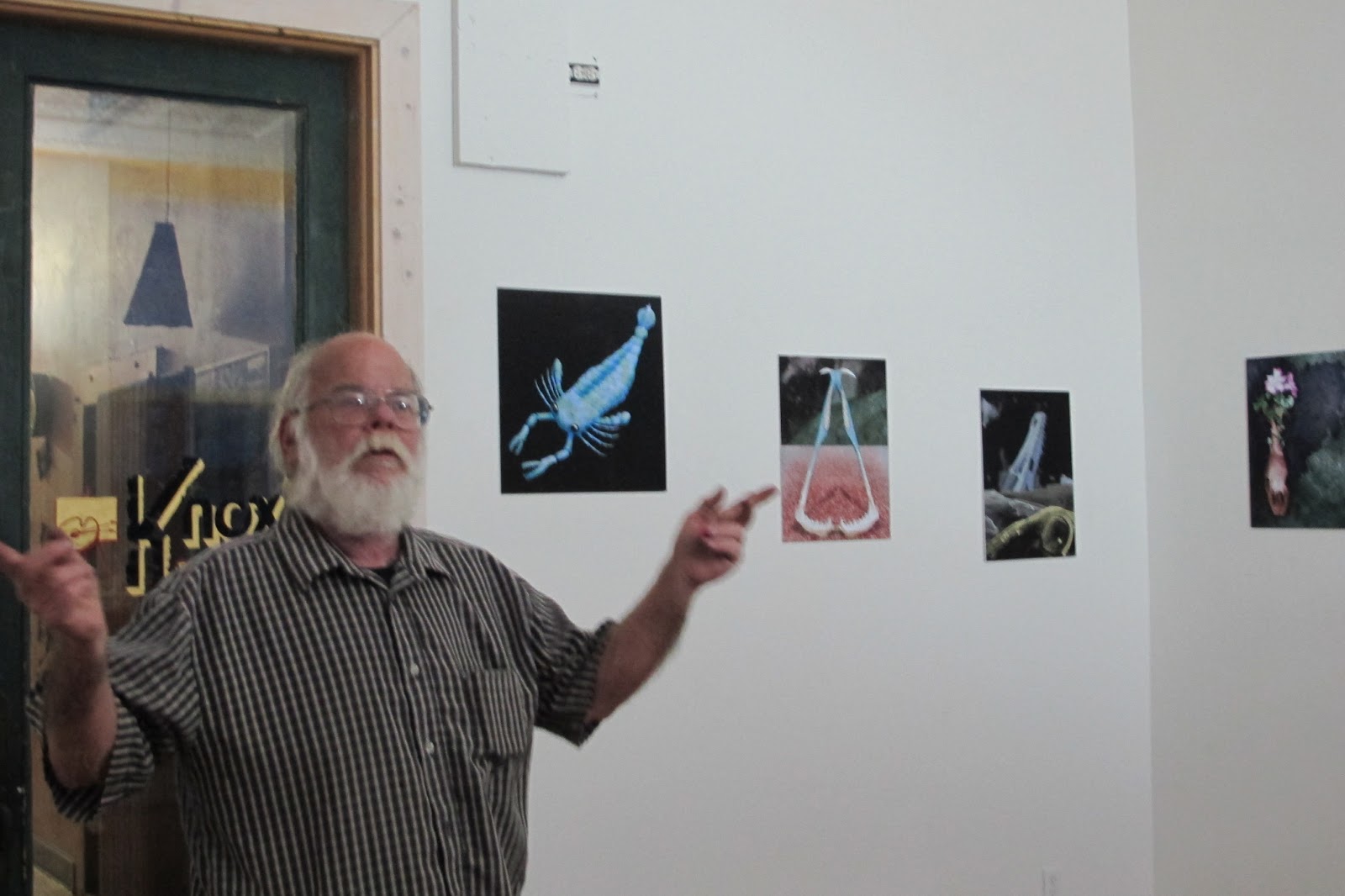
Here's Dave Kirk in the gallery space at Aunt Dofe's Hall of Recent Memory. Everybody has to be nice to Dave from now on.


So they take me out to a back road in Montana, and I figured this was my chance to do some Western art. "Here I am, doing Western art," I thought to myself, and when I was done, I showed it to people and said, "See? I'm not afraid of Western art." I drew a cow, as well. I'll let you see it later.

When I got home and looked at my 'Western' art, I laughed out loud at what happens if you go far enough west...

Every day is backwards day. So of course, when I went to Montana for my show at Aunt Dofe's Hall of Recent Memory, I spent my time entirely in the company of people from the arts, academia, and broadcasting. The one civilian I listened to for any length of time turned out to write a column for a fishing magazine. And most of 'em were probably more conscientious lefties than I.

So go figure.

It was a ridiculously gratifying experience. I was treated as a precious object, I behaved as a humble servant, and the results were pleasing and harmonious. My pal Deborah (familiar to long-time readers) made sure I ate and walked every day, and arranged regular encounters with animals. I need a certain amount of physical affection, and without the missus and our dogs, horses, dogs, cats, cattle, and observed wild animals serve as palliative drugs. (Deborah's comment at the end of the trip -- "Animals compete for your attention, and people give you stuff. What's up with that?" -- was the last nail in the coffin of my former self-image. I am not an outcast, but rather one of those who glitters when he walks, and that boils up a whole fucking other kettle of worms. If I act like the sullen wretch I am, it comes across as arrogant or threatening rather than pathetic. I'm starting to feel that smiling and acting nice are responsibilities I've been shirking.)

But the whole scene wasn't about me, and I liked that. I was one of the main engines of the event, but an engine isn't an aeroplane. Dave Kirk, the curator of Aunt Dofe's, had gone through a fallow period, and this had been (or at least this is the impression people gave me) a source of hardship in the creative community. "Dave/Aunt Dofe's is the best thing to happen to Montana in a long time," was a statement I heard repeated from many mouths with the regularity of a chirping cricket. So a new season of shows at Aunt Dofe's was exciting news, a sort of cultural springtime.

Working on the sort of budget one gets for art produced outside the academic or commercial worlds, with access to any number of friends and colleagues who are known in the world of the arts, who have shows ready to go, who have pull and connections and collectors and so on, Dave, like an arrow straight to Hell, chose to go with an almost completely unknown artist, working in an eccentric, somewhat kitschy style, who would need complete sponsorship in order to participate.

On the night of the opening, I heard two phrases repeated over and over from a lot of different people. The fishing columnist (who I'm not ribbing) wasn't there, so it was all, you know. Arts types. Real arts types. Working, academics, broadcasting, like I said.

Some of them fixed me with an intense gaze, obviously meaning to drive some thought into my brain with the force of a wooden stake. "You do understand that this is one of the best gallery spaces in the world, and Dave is one of the best curators in the world, right? You do understand what that means?"

Well, I'm still in the process of understanding that one, but yeah, I kind of get it.

The other thing people said? "Thank you."

Like I said,  still processing, kind of get it.

Here's the thing.

I'm proud of the show. There are two booklets there, A Bad Part of Town, and Swimming Crawling Walking Flying, that have been printed in editions of thirty, available only from Aunt Dofe's. There are fourteen images accompanied by thirteen poems. I did a walk-on reading early in the show, and would have done more except the band -- Fear Eats the Soul, and I wish I could find a good link for them -- caught fire, and to interfere would have been worse than a sin. It would have been a mistake.

But it was the way people swung through the event and picked up a charge that got me. That was my reward, that was my payoff. There was a buzz, there was energy, and there was a sense of harmony, of things operating in their proper sphere. People were enhanced by their interactions. And that was what I helped create with my art, and with my labor, and with my person. The essential scene, the music, food, drinks, and guests, could have happened without me.

But having me there gave the scene specificity and novelty. Hey, these are some of the coins art brings to the table. Happy to oblige. Thanks for having me.

I used to say that I was good at arrogance and shame, but pride and humility were incomprehensible to me. That's changed. Pride is knowing your strength, and humility is understanding that strength is responsibility rather than license, that strength is a gift others paid for.

There was no point in the artistic process where I felt doubt or worry. Nerves, yes. That's how I'm built. But the sense of complete confidence I felt throughout seemed the simple and proper result of understanding the range of my abilities rather than hubris. And those abilities seem not so much a part of me but rather a public trust -- I can do what I do because people invested in me. Time, money, and tradition have been granted me. It is appropriate that I do honor to the gifts I've been given.

Over the period of time, six months or so, not even a year, my life has undergone a series of changes, some startling, some the obvious outcome of the way I conduct myself in life. I have a publisher, and my next novel will be released in early 2014. This Saturday, I'll be reading and helping host a reading as part of this year's Beastcrawl. I am operating at a very eccentric intersection of fine art, popular culture, and science, and whatever it is that I am is still in the early stages of emergence. I'm nearly fifty; by the time I find out what I am, I'll have fifteen, twenty years worth of career if I score big. (I won't turn down more than that, but really, let's not be greedy.) Robertson Davies went downhill for his last two novels, but Hokusai went from hack to genius in his dotage. I seek to emulate Hokusai...

Man, I'm out of it. Thinking about my last-days work while doing this-days work. Processing, processing.

I'll talk more about the show later. But for now, know this. Deborah Kuchar and Dave Kirk got together and gave me one of the very best weeks I've experienced in my life. They went to expense and effort, and I hope very much that they got what they wanted.

Because I have been enhanced, and I hold them responsible.

Thursday, June 13, 2013

My First Solo Art Show


The above two images are the covers of two pamphlet-format publications. They will be used at my upcoming show this month at Aunt Dofe's Hall of Recent Memory. That's right, I'm going to be traveling to Montana, and if anyone can guide me in the direction of some Zappa-themed novelty floss, I'd be mighty grateful. And yes, A Bad Part of Town is going to have its spine to the right, and will be read back to front, and the whole show is full of that kind of crap because what the hell were you expecting from me?


Okay, folks. This may or may not be the last post for this site, but I've got a brief moment where I have the option of telling y'all what's going on.

I am, among other things, in the final stages of preparing for my first solo art show. This show will bring together my writing, my visual art, and my performance in one package, and if I can pull this off, you can expect more along those lines.

I had two conceptual issues to face in this project. The first is one that came to light in discussion with one of my oldest friends. (Those close to me have been startled by a recent burst of personal progress; it is the result of this friend going to great effort on my behalf, and I acknowledge this with much gratitude.) We were discussing the nature of art, and specifically the nature of printmaking. I'm a digital artist. Have been from the first time I held a Wacom stylus in my hand and I knew there was a way of communicating with a computer. I've been using Photoshop since it came on floppies, okay?

But now there really is no comparison between a woodblock or an etching and the object that rolls out of a printer. I argued against it at the time, but in retrospect, the idea grew in me that simply producing a print isn't enough.

I was also facing the idea that the museum, the gallery, and even the publication, for better or worse, outrank the art. They are there for the sake of the art, but they frame it, enclose it, and give the experience of art it its most essential physical qualities.

This realization depressed me, until I realized that it meant I had to take responsibility for the interaction between art and publication, or, in this case, between art and the gallery. What happens in the gallery space is the art, not the individual images on the walls. The images are offered for sale as much as memorabilia of an event as artworks in themselves. My job was not to produce images for display; my job was to take years worth of my art and writing and use them to convert the space into something unified and meaningful.

I could not engage directly with the gallery, although Dave Kirk, the owner, gave me some solid pointers on lighting. I did have the floorplan. At first, I used it simply as a means of referencing the measurements of the walls, but after poring over it blindly, I suddenly saw the essential shape of the space, the way it was divided, and the way people entering it as a gallery might move.

The four walls resolved themselves into two facing L-shapes, separated by doors. The short arms of the Ls receive west light, which is strong and varied, and seem to be the most visible from the street. So they get saturated colors, strong contrasts, skulls, monsters, and so on.

The pieces are in two parts. One is the image, and the other is a short poem functioning as a title. Most of the images are fifteen inches wide by twenty inches high; the poem/titles are on placards about nine inches by three inches. On the right side of the studio, the poems are aligned to the left of the placard, and the left edge of the placard is parallel to the left edge of the image. This unbalanced composition will lead the eye down and to the left, so that it will be natural to follow to the back door.

The pieces on the left will be leading the viewer to the right, again to the back door. With any luck, this should lead to a sort of swirl in the space, with a strong possibility that the viewer will travel in a figure-8 path.

In addition to the art on the walls, there were a number of pieces in this sequence that were best viewed as small black-and-white pieces. Rather than put them on the walls where they'd be overwhelmed by the large color pieces, I made two booklets combining writing and art in some odd ways. There will be two reading stations on site, one devoted to each booklet.

I'm really hoping that the combination of words, pictures, and interior design will push this a little further than the ordinary art show. And since I'm going to be performing at the opening, this will pretty much represent the maximum Sean the world has seen at any one time thus far.

You'll hear about it one way or another...

Friday, May 3, 2013

The Next Phase Has Begun

I can't tell you much about what happened over the last week. Let me put it this way.

Best. Sean. Story. So far. An amazingly fictional, mythological experience just choking with extremes and intensity. Ask me in person. It's mind-bending. James Herriot meets Rupert Pupkin.

But to cut to the chase.

I am as a phoenix risen from the flame. I am able. I am employed as an apprentice in a fascinating and lucrative profession, and I'm getting in through a side door. I have begun training to shape my body into a beautiful weapon. I have finally begun my course of instruction at Man School. I am being prepared to take a place in the one percent.

I know what I am now. There aren't any words for it these days, but there is a class of people like me. I have a fellowship, a guild, a history. Our core values are intellectualism, aesthetism, valor, honor, and excellence. I had the first two and the last, but without valor and honor I was part of a man. Now I am whole.

I have started taking steps toward real, actual adulthood. I will be engaging with the world on its own terms instead of dictating my own and grinning as the world flays me in response. My purity is over. I will have to contend with my core values as obstacles as well as virtues.

And I will need to access pleasures previously too -- sinful? degraded? -- for my previous self. Pride, vanity, competition, desire, all have to be embraced if I am going to be able to move in the circles into which I am being pulled. I'm going to be swimming with sharks, so this gator needs to smooth his moves and sharpen his teeth.

I'll be starting a new blog with a different title. Self-deprecation isn't appropriate for my current path. And I'll be going over this blog and reducing it to a 'best-of' collection, with all references to my personal frailties excised. I no longer approach life from the perspective of a victim, and wish to distance myself from that stance. No insult to anyone else; my attitude toward others is unchanged. But I've let fear govern my life to too great a degree for too long, and now things are different.

My life as an artist will continue unabated, and can only benefit from this new direction. Most of my independence has been left to me; what has been taken is the opportunity and desire for indolence.

Aspects of my character that have previously been unbending laws will now have to be guidelines and preferences. The fierce purity I have maintained through my life is no longer compatible with a course of honor.

And so.

Don't worry about me any more. I thrive. Don't think I'm going away. I will be more in touch than I was before. I'm thrashing with my new computer set-up, but I should be fully back on-line in short order. There will be a phone, and a mailing list, and business cards, and all the happy paraphernalia of a professional approach to life.

Now I'm going to go walk around and feel something strange thrum through my body as I absorb the fact that I don't hurt and I'm not doomed and tomorrow will see me stronger than today. See y'all around, and give my best to your family.